GAME ON
october 23 and 24 at Dansens Hus in Stockholm
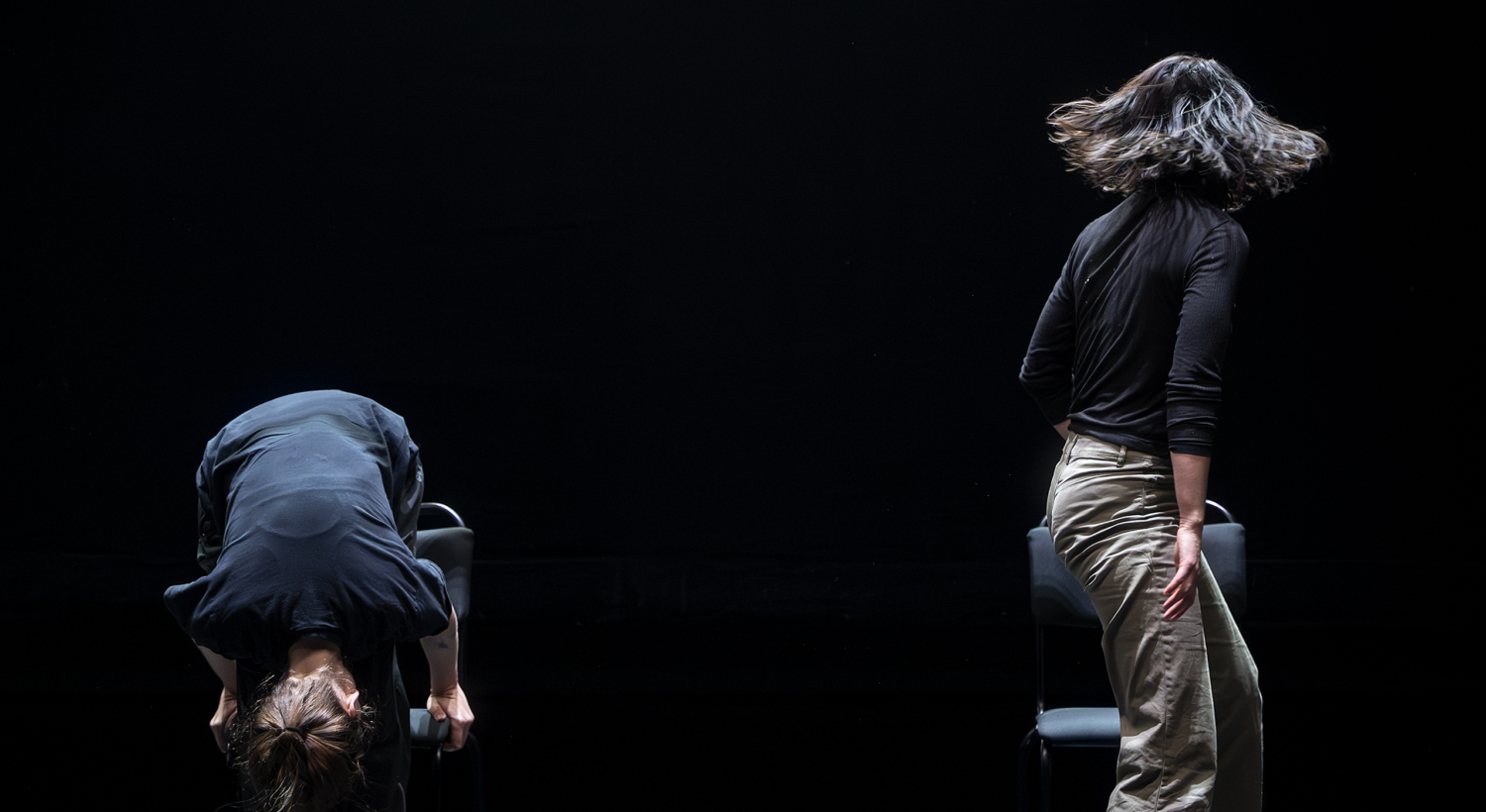
An enterprise renounces its own progress to instead engage in a strictly held inward motion whose inevitable outcome is an outward thrusting turbulence in turn revealing a prolonged undertow that is not afraid of its time-consuming drive which at its outermost edge flips into a vibration that must turn into a phonetic standing wave whose downward-targeting pharyngeal cacophony in its lack of liability ensures a well compounded dance no longer dance much more and deeper into its dance. In this place. Now and not later.
space ⌊ choreography cc
space ⌊ lights Thomas Zamolo
sound Richard Chartier*
dance Samuel Draper Shai Faran Maja Grimsted Nelia Naumanen Louise Perming Yari Stilo Ellen Söderhult
‘a field for recordings 2’ (2007) ‘a field for recordings 3’ (2007) ‘(sketch for) deletion’ (2007) ‘fly08’ (2010) ‘wire.re’ (2010) published by Touch Music/Fairwood Music UK Ltd
one foreplay
Around the corner from GAME ON, a foreplay suggesting the state of calm and troubling emptiness that GAME ON both presupposes and generates.
film Scott Morrison
lights Thomas Zamolo
sound editing Luciano Villace
space ⌊ choreography cc
space ⌊ graphic design Eleonora Bergendal LA STRADA
the outcries
Along the walls leading to the foreplay, series of posters from the ccap project TEN CALLS2026 whose forms and motives are framing the ethical-aesthetic landscape that GAME ON performs.
Farther away, a few towers loaded with scrap. Why unsaid, other than that they point to the qualities that GAME ON has discarded yet maintains, that is, still performs, in the form of an underlying ontological privation.
space ⌊ choreography cc
space ⌊ graphic design Eleonora Bergendal LA STRADA
ccap2026 production in co-production with Dansens Hus
with financial support from Statens kulturråd, Stockholm Stad, Region Stockholm
THANK YOU Dansens Hus technical team
particularly Luciano Villace (sound) Pär Ibbing (lights) and Nisse Lennartsson (stage)
GAME ON THE FACTS
loosely driven strictly maintained structures in increased stringency and irresponsibly
dances in components evenly distributed over geometric grids
The dancing climbs up on the stage and measures her steps. Clearly goal oriented. Reluctant its own closure.
In repeated attempts facing the lack of completion. Thanks to a proposal without a forward strive.
The stage is empty, filled with assumptions.
Scrap in components floats midair. With tonally confident steps. So that the space opens to what shifts.
Bodies participate in occasional appearances. With movements that remain in precarious oscillation.
But that is not important. What should emerge is the image. And the tonality that image suggests.
The one that amazes. And cannot be grasped. Thanks to the dance’s inward moving outward thrust.
The game wants to begin.
The image lingers over the playground. Indifferent. In continuous drive. Without any claim of refined exposure.
Soon lulled into a self-sustaining reverb, wrapped in a disenchanted life.
As if it were a dance. Or a twisted projectile.
the initiative piles up into a mountain the mountain moves halfway up among the clouds
in the middle of a desert in the middle of a hurricane all pieces gathered to the already airborne
Becoming in overlap with dismantling. Accumulation and fine distribution at once.
The mountain leaves its easily flammable body and forges the tightest angle.
In a pendulum movement worthy of a singular artistic statement.
The dance sharpens her call. The place widens its angle.
GAME ON IN THE MATTER
A wildly flailing, strictly held dancing renounces her own progress. In a build-up and tear-down euphoria that turns everything into a countercurrent. Where she is not afraid to change gaze and rules. In fact, ready to intertwine with the course of things.
Straight into an unmanageable wide-angle operation, whose smallest component is given excessive attention.
Where the dance bets her strongest cards on a carefree on-and-off state of (att)tension.
For the thing in itself. With no claim for personal gain. Or fear of loss. The dancing plays a non-zero-sum game*.
Which is why she can afford to be optimistic.
The stage, for its part, is a two-dimensional playground, specifically shaped for a one-way viewing of a game expected to lead to a win-or-lose outcome. A zero-sum game. In fully negotiated agreement with market measures. Culture today.
Playground and game definitely out of step. No winning potential for anyone. But not a loss for anyone either. Rather, we trust that this GAME ON can secure a mutually beneficial outcome for both parties. Despite the parties’ more or less locked positions, as is often the case in a dance performance. Here, instead, there is the possibility for a moving exchange. Game and audiences reciprocally disturbed and moved.
Thanks to the dance’s sustained enthusiasm, as it must be.
carefree positioning according to a predetermined score regardless of in what situation or circumstance
in mutual confession in well-deserved mutual recognition
GAME ON plays several games in overlap. On a playground governed by assumptions foreign to the dancing games’ own biases.
Other, polyphonic orders and perspectives are redistributed. Game, playground, and audience in divergent interaction with the making of a dance.
And the dismantling of the playground. In a daring venture. Dangerously close to a collapse. Yet not.
GAME ON fears no crisis. Nor any loss. Rather, it trusts that something will be redistributed.
And that the very idea of winning and losing will be reconsidered. Which is why it bets everything on its most narrowly angled play.
Knowing that the dancing will remain the same. Even when already different.
Not fully played yet. But fully announced.
*
A non-zero-sum game is a game driven by careful negotiation between the playing parties, through which, regardless of the parties’ potentially uneven initial situation and conditions, the game reaches a redistribution of both gains and losses that is advantageous for all parties, in other words, a game that ensures a win-win outcome for everyone.
GAME ON PREVIOUS CHOREOGRAPHY
in a rather obtuse and incomplete manner
seven laconic endeavors
⌊ in voluntary restraint ⌊ in interrupted review ⌊ in prolific undulation ⌊ in repeated acceleration ⌊ the undertow
⌊ open mouth widening ⌊ in minimal vibration** ⌊ in sucked tongue
by and with cc
I am thinking of barely noticeable movements at an acute angle, in short-lived series, occasionally interrupted by unjustified behaviors. Perhaps even a skimmed reading. In conversation with an extension of meanings towards the wide-angled. That said, it all seems very pretentious. It shouldn’t be. My intention is to be very specific in the restrained.So that the dancing can ‘clear the room’*** and by that broaden and at the same time delimitate the view.
From an email correspondence with Silvia Bettiroli before meeting in Milan & Turin.
cc May 20 2026
*
The work relies on a reading of TUNG, a collection of writings from a decade of cc / ccap dancing. The title TUNG, and of this tongue, alludes to the fact that the book, like this dance, in fact are ‘heavy’ (Swedish: TUNG). But also, a prolific manifestation of a tongue (Swedish: TUNGA) that is light, untethered, dispersed, and highly plastic. Always in motion. Easy to ‘browse.’ Impossible to catch.
**
Among many other relevant references, see Trasumanar e organizzar,a collection of poems by Pier Paolo Pasolini that explores the tension between transcendence (the irrational and the mystical) and political action (organization and revolution). Published in 1971, it marks a radical departure in his poetic style. *** To paraphrase La mente sgombra by Giorgio Agamben (2023).
GAME ON YIELDING
REPERCUSSION
unifying title for a reassembled choreography in four parts
by and with cc / ccap
redoubling
cc speedy material split into sixteen parts, danced by multiple dancers, in anadiplotic* order
sound Richard Chartier Subsequent Materials track 13, Feedback – with AGF (2011)
the doppelganger
cc solo divided into five parts, danced by multiple dancers, in original order, with overlaps and / or in between gaps
sound Richard Chartier A Hesitant Fold (1999) track 3, Arranging Between Patterns
laconic ** poses
cc solo is danced in the form of passing poses by several dancers in original chronological or indefinite order
sound Richard Chartier A Hesitant Fold (1999) track 3 Arranging Between Patterns and in the following silence
the filibuster ***
cc chair material is danced by at least two, or more performers sitting amongst the audience along the perimeter, while someone performs an extended lecture. Possibly in overlap with the laconic poses.
*
Anadiplosis (Greek: ἀναδίπλωσις, anadíplōsis; “reduplication”) is a rhetorical figure that consists of the beginning of a sentence being a repetition of the end of the previous sentence (from Wikipedia).
**
Laconic means expressing oneself briefly, tersely, or succinctly.
It often describes a person or statement that gets straight to the point without unnecessary words but still says a lot.
***
The filibuster (Swedish långbänk), to ‘drag something out on the long bench’, means to stall, delay, or deliberately postpone the core issue of an issue.
The expression refers to a process that drags on so long that it might, in the worst case, be forgotten.
According to Wikipedia: The expression comes from the furnishings of peasant society, where a fixed ‘long bench’ ran along one long side of the room. This bench didn’t just serve as a seat, but also as a practical storage and resting surface for all sorts of everyday items needed in the home. When things were placed on the long bench, they ended up at the back of the pile and often remained there without anyone dealing with them. Over the centuries, this practical everyday pattern developed into the figurative metaphor we use today, where errands or political decisions literally ‘get left lying’ on the long bench.
Another interpretation according to the internet: Långbänk, to drag [something] in långbänk, is an informal political expression for an issue that is debated for a long time without being implemented. The expression has been used in Sweden’s parliament where a political issue can be repeatedly handled by the different parties and constituencies (the benches) without reaching an actual result due to disagreement between the parties and constituencies. Thus, the issue goes back and forth between the parliament benches and no agreement is reached. The expression has a negative connotation and is seen as highlighting the flaws of politics.
A second interpretation according to the internet: Långbänk, to drag [something] in långbänk, is an informal political term for an issue that is debated for a long time without any execution. The expression has been used in the Swedish Parliament where a political issue can be repeatedly discussed by the different parties and constituencies (the benches) without reaching an actual result due to disagreement between the parties and constituencies. Thus, the issue goes back and forth between the parliament benches and no agreement is reached. The expression has a negative connotation and is seen as highlighting the flaws of politics.
According to the Swedish Academy Dictionary, the word långbänk has been documented since 1635 in the meaning of a fixed bench along a long wall or along the long side of a table. Equally old is the expression to drag something on the långbänk, meaning to prolong, defer, postpone, or fall into oblivion.
GAME ON FINAL WASTE
THE ADDICTION
two live installations in a long-awaited forced choreography
by and with cc / ccap
clearance or the uncomfortable terrain aka the ever-grateful redoubling.
Recovery of a silver terrain and disposal of white chairs, with or without subsequent frontal chair-bound material
leading to scattered laconic poses. With at least four dancers and six clearing colleagues.
A crucial condition for the dance to even start moving is that a somewhat nearby part of the brain, body, place, and surrounding conversation, to be able to receive her, has already been cleared *. At least temporarily. After that, all you need Is a slight push-off and you will dance for a lifetime. Provided you agree with the dance’s demand for constant fragmentation of the previous in well-measured repetition.
*
To paraphrase Giorgio Agamben ‘La Mente sgombra’ (2023).
a cluttered room, that is, the towing * of an insight, that is, the recurring filibuster.
Chipped mirrors fake spoons white chairs and undulating dances (with or without dancers).
When the dance leaves her background, she looks forward to an exponential doubling of the same.
Where neither image nor positioning can be fixed anymore. And the sum of what is depicted always leads to a standing wave**.
*
Towing an insight (trying to get an idea moving or move a conclusion forward) that has also ended up on the ‘long bench’ (been postponed in an endless process) requires energy, the right equipment, and a good portion of patience. To clarify this wordplay, Long bench, a Swedish expression for issues, matters, or decisions that are consciously or unconsciously postponed to the future without any real work being done.
Towing: If we take it to the extreme (literally), it means towing a vehicle that cannot drive on its own. Towing a car requires knowing basic safety rules – like the maximum speed being 30 km/h and that the rope must be no longer than 2 meters.
**
The concept that describes when two waves move in opposite directions and overlap (one ‘slides under’ the other) is a standing wave.
What is it? It’s a phenomenon where the waves don’t seem to move sideways but instead appear to vibrate in place. How does it happen? When two waves with the same frequency and amplitude move toward each other, points that are always still (nodes) and points that move maximally (antinodes) are created. Example: Standing waves occur, for instance, when playing on a guitar string or in physics experiments.
A standing wave is a wave phenomenon that is formed by two wave motions moving in opposite directions and superimposed (overlaid) on each other.
This creates nodes and antinodes. The wave appears to stand still – a standing wave. It only oscillates up and down (for a transverse wave) or back and forth (for a longitudinal wave). The wave has its greatest amplitude at the antinodes and the least at the nodes. The distance between nodes is half a wavelength. Standing waves in their basic form are non-resonant. Non-resonant standing waves occur, for example, between a sound source and a reflecting surface, meaning when a sound from a source is reflected off a cross-section with lower or higher acoustic impedance than that present in the wave, that is, the medium’s acoustic impedance. Resonant standing waves (resonances) are a special case that occurs when a sound is reflected infinitely many times, for example, between two parallel surfaces. See also resonance. (From Wikipedia)